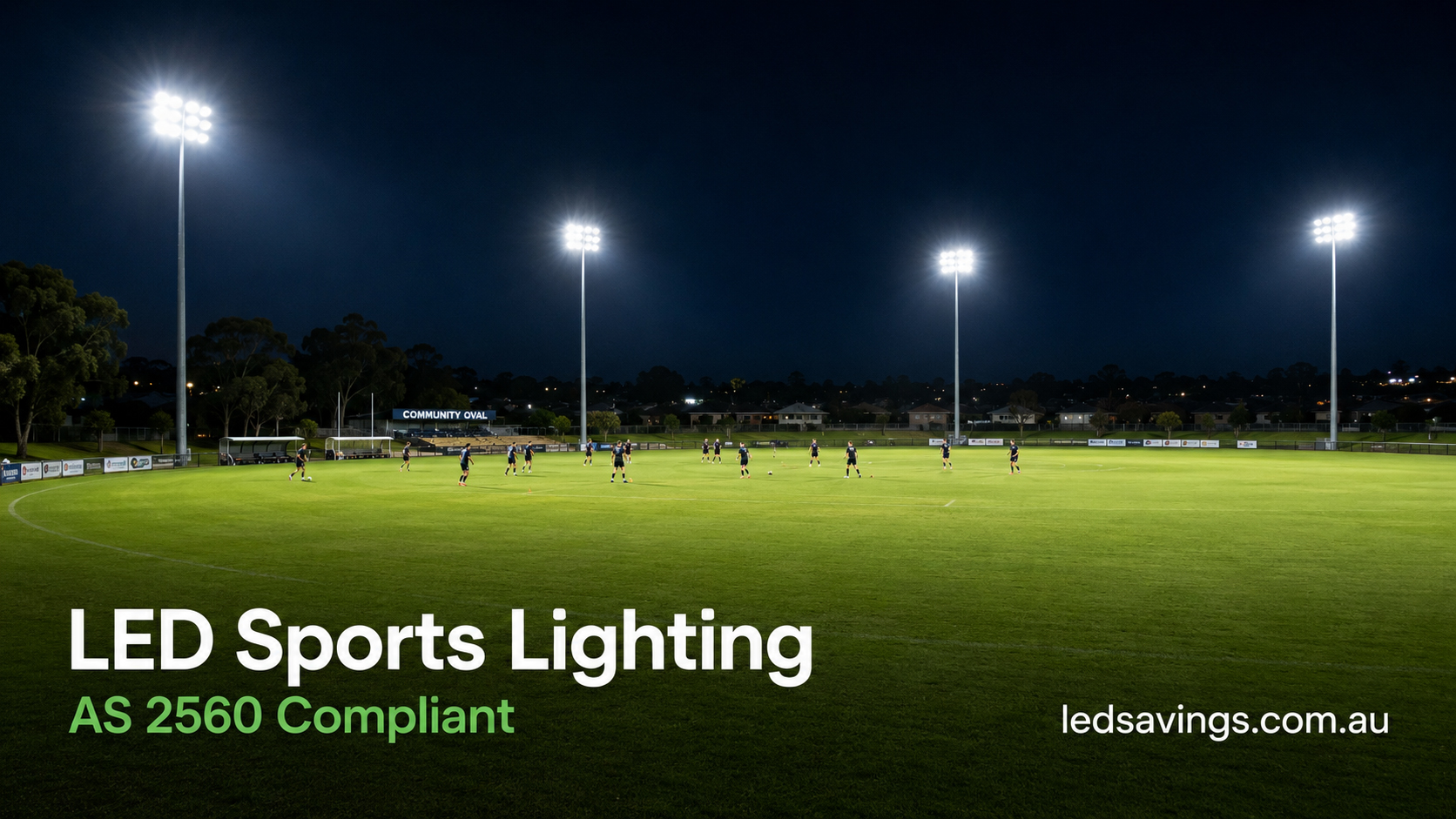
The club secretary sends the ground coordinator a message at 6:45pm on a Tuesday. "The lights are on warm-up again." Twenty minutes later, the juniors can finally train. Metal halide floodlights take 15 to 20 minutes to reach full brightness, and if someone trips the circuit or flicks the switch off by mistake, there is another 15-minute cool-down before restrike. You cannot restart them hot.
That is the least of the problems. A 1,000W metal halide lamp operates at around 75 lumens per watt. A modern LED sports floodlight runs at 140 to 170 lumens per watt. The metal halide also degrades to around 70% output within 6,000 hours of operation, while still drawing full power. A facility running four poles of four 1,000W fittings for 1,500 hours per year pays for light it stopped receiving two years ago.
This article covers what Australian standards actually require, what the numbers look like for the most common sports, how to handle spill light and glare for neighbours, and what grants are currently available by state.
Corrected 15 August 2026: this article previously used the incorrect designation “AS 2560” (AS 2560 is an Australian-only standard, not a joint AS/NZS document), cited AS/NZS 4282:2023 instead of the current AS/NZS 4282:2023, reversed the U1 and U2 uniformity definitions, and presented a Class I–V ladder that does not match AS 2560’s real structure. The lux table has been rebuilt using two free, verified sources: Queensland Government’s Sports Lighting Best Practice Guide (including its own sample lighting audit form) and Wingecarribee Shire Council’s 2025 Sports Field Lighting Plan, both of which quote AS 2560 figures directly. Sports not covered by either source have been removed rather than estimated.
Two standards frame every outdoor sports lighting installation in Australia.
AS 2560 is the primary sports lighting standard, published by Standards Australia. It is not a joint AS/NZS document. Part 1 (AS 2560.1:2018) sets out general principles: maintained illuminance, uniformity ratios, glare rating (GR) and measurement methodology. Part 2 used to be split into eight separate single-sport standards, covering football codes, cricket, tennis, netball and basketball, bowls and others. These were consolidated into a single document, AS 2560.2:2021, in August 2021. There is no current AS 2560.2.1, 2560.2.3, 2560.2.5 or similar sub-part: any reference you see to one is citing a withdrawn standard.[1]
AS/NZS 4282:2023 (Control of the Obtrusive Effects of Outdoor Lighting) governs light trespass, sky glow and glare affecting surrounding properties. It is a joint Australia/New Zealand standard, and the 2023 edition superseded AS/NZS 4282:2023. Councils now use it as the standard benchmark when assessing development applications for new or upgraded sports lighting. If your photometric report does not address AS/NZS 4282 compliance, a council objection from an adjacent resident is likely.[2]
Both standards apply simultaneously. A sports lighting design must meet AS 2560 for the playing area and AS/NZS 4282 for the boundary. Getting one right at the expense of the other is a design failure.
What "maintained illuminance" means: The lux levels in AS 2560 are maintained values, not initial values. They account for lumen depreciation over the life of the lamp. With metal halide, the maintenance factor is typically 0.65 to 0.75. With LED, it is typically 0.85 to 0.90. This means an LED system designed to deliver 200 lux maintained requires less initial output than a metal halide system targeting the same maintained figure, which is one reason the wattage reduction is greater than the efficiency difference alone would suggest.
AS 2560.2:2021 sets minimum maintained illuminance by sport and level of play. There is no formal Class I–V ladder in the current standard; play levels are described by name (community use, training, competition) and, for court sports, by the geographic tier of competition (local, district, regional). The figures below are drawn from two free sources that quote AS 2560 directly: Queensland Government’s Sports Lighting Best Practice Guide and Wingecarribee Shire Council’s 2025 Sports Field Lighting Plan. Sports not covered by either source are not included rather than estimated.
| Level of play | Maintained illuminance | Standard ref |
|---|---|---|
| General community use | 50 lux | AS 2560.2:2021 |
| Training | 50 lux | AS 2560.2:2021 |
| Basic competition | 100 lux | AS 2560.2:2021 |
The 150 lux note: AS 2560.2 includes a note recommending 150 lux as a preferred minimum for AFL competition, even where the nominal threshold is 100 lux. Queensland’s Sports Lighting Best Practice Guide (Sport and Recreation Queensland) specifically reflects this in its own sample audit form (150 lux average, club competition and match practice) and recommends designers target 150 lux maintained for any field used for evening competition, not just AFL.[3] Many councils now mandate 150 lux as their minimum for community ground approvals.
| Sport | Local | District | Regional | Standard ref |
|---|---|---|---|---|
| Tennis | 200 lux | 200 lux | 300 lux | AS 2560.2:2021 |
| Netball | 200 lux | 200 lux | 300 lux | AS 2560.2:2021 |
| Multi-purpose court | 200 lux | 200 lux | 200 lux | AS 2560.2:2021 |
| Hockey | 250 lux | 250 lux | 350 lux | AS 2560.2:2021 |
Cricket, athletics, lawn bowls and softball / baseball are also covered by AS 2560.2:2021, but this article does not reproduce specific figures for them here: neither of the two free sources above covers those sports directly, and the figures previously shown for them could not be independently verified. Get current numbers from a qualified lighting designer working from the actual standard.
A field averaging 200 lux where one end sits at 80 lux and the other at 320 lux is not a well-lit field. AS 2560 specifies two uniformity ratios.
U1 is the minimum-to-average ratio. A U1 of 0.5 means the darkest point on the field is at least 50% of the average illuminance across the field. This is confirmed directly in Queensland Government’s own sample sports lighting audit form, which defines U1 as min/avg and requires U1 ≥ 0.50 for AFL club competition.[3]
U2 is the minimum-to-maximum ratio: the darkest point compared against the single brightest point anywhere on the field, rather than against the average. The same audit form requires U2 ≥ 0.30 for AFL club competition.
Poor uniformity is the most common failing of older metal halide installations. Four poles at the corners of a rectangular field, each with a 1,000W fitting tilted inward, produce reasonable average lux but terrible uniformity: the centre of the field is bright, the corners are dark, and the sidelines fade off sharply. Players and umpires notice this. Footage from council-league football grounds often shows exactly this pattern.
LED sports optics have advanced considerably. Modern asymmetric flood optics allow designers to distribute light across the field with much tighter uniformity than metal halide could achieve from the same pole positions. A good LED photometric design can achieve meaningfully better U1 and U2 figures from pole configurations that struggled to meet the standard with the previous metal halide array. This is not just a power reduction. It is a genuinely better lighting outcome.
Glare Rating (GR) quantifies the discomfort glare experienced by players on the field. It is measured on a scale where GR 10 is imperceptible and GR 80 is disabling. AS 2560 sets a maximum allowable GR by sport and level of play. Queensland Government’s own sample AFL club competition audit form confirms a maximum GR of 50.[3] Requirements for other sports and higher levels of play vary and should be confirmed against the actual standard or a qualified lighting designer rather than assumed.
Metal halide sports fittings are point sources with relatively poor optical control. They produce significant glare, particularly for players looking toward the lights (which happens constantly in aerial sports like AFL, cricket and golf). LED sports fittings use multi-chip arrays with precision optics, which distributes the light source across a larger area. This reduces the peak luminance at any single point and lowers the calculated GR for the same illuminance level.
The practical effect holds even without quoting specific before/after numbers: a well-designed LED sports installation consistently measures a lower GR than the metal halide array it replaced, at the same or better illuminance. Better player comfort, fewer complaints about glare, and an easier path to formal compliance.
Spill light is the light that leaves the playing area and falls on surrounding properties, roads or sky. It is the primary source of objections from neighbours of sporting facilities, and it is regulated under AS/NZS 4282:2023, which superseded the 2019 edition and renamed the standard’s environmental zones from the old A0–A4 system to the current E0–E4 system.
The standard sets limits by environmental zone, from E0 (intrinsically dark, e.g. national parks and observatories) through to E4 (high district brightness, e.g. town and city centres), and by time of night (pre-curfew and post-curfew, with curfew generally applying from 11pm to 6am). Most suburban sports grounds sit in a medium-brightness zone rather than the lowest zone: a sparsely inhabited rural area and a typical suburban street bordering a sports ground are different, differently-regulated zones, and getting this classification wrong in either direction is a genuine compliance risk, not a rounding error. The specific numeric limits (vertical illuminance at the boundary, upward light ratio, luminaire intensity) for the current 2023 edition sit in the paywalled standard and are not reproduced here rather than guessed at.
LED sports floodlights with good asymmetric optics have very low upward light ratios, typically under 1%, compared to metal halide which sends a significant portion of output above horizontal through the diffuse glass envelope. The optical precision of LED means far less light ends up on neighbouring fences, bedroom windows and the sky.
When preparing a photometric report for a council DA, the report must include an AS/NZS 4282 compliance table showing vertical illuminance at the nearest affected properties, matched to the correct environmental zone for that specific site. Most LED sports lighting suppliers can provide this from DIALux or Relux photometric calculations, but only if they are asked. Request it upfront, and confirm which zone the designer has used and why. It is far easier to optimise the design before poles go in the ground.
Photometric report checklist: Any sports lighting DA submission should include a plan view of horizontal illuminance (lux grid), a uniformity report (U1 and U2), a glare rating calculation (GR at player eye height), vertical illuminance readings at the nearest residential boundaries, upward light ratio, and a compliance table against the relevant AS 2560 level of play and AS/NZS 4282:2023 environmental zone. If any of these are missing, the report is incomplete.
The wattage reduction from metal halide to LED is driven by two factors: efficiency (lumens per watt) and maintenance. A 1,000W metal halide produces around 80,000 lumens initial, but degrades to 56,000 lumens maintained (at 0.70 maintenance factor). A 400W LED producing 60,000 lumens initial at 0.88 maintenance factor delivers 52,800 lumens maintained. Similar maintained output, 60% of the wattage.
These ratios assume equivalent maintained lux on the field. A straight wattage swap without a photometric design will not produce equivalent results: LED optics are fundamentally different from metal halide optics, and a 400W LED fitted into an existing metal halide housing with no optic change will underperform what the numbers suggest.
Do not retrofit without a photometric design. Replacing metal halide sources with LED sources in existing housings, at existing pole angles, without running a photometric model is a common and avoidable mistake. The optics are different. The aiming needs recalculating. An LED floodlight aimed at the same angle as the metal halide it replaced will produce a different light distribution pattern and likely different uniformity. Commission a DIALux or Relux calculation before ordering product.
Metal halide lamp replacement at height is expensive. A typical sports lighting pole runs 10 to 15 metres. Access requires a cherry picker or elevated work platform, a traffic management plan if adjacent to a road, a licensed electrician, and replacement lamps. A lamp replacement programme for a four-pole facility running sixteen 1,000W fittings might cost $8,000 to $15,000 every three years, including access equipment hire and labour.
LED sports fittings rated at 50,000 hours L70 at a 1,500-hour-per-year usage rate last over 30 years before reaching the maintenance lumen threshold. In practice, most sports facilities plan a 15 to 20 year replacement cycle and budget for one access visit in that period. The maintenance cost saving is often as significant as the energy saving over the project life, and it does not appear in payback calculations often enough.
LED's instant-on characteristic enables something that was impractical with metal halide: truly on-demand lighting. A facility running a booking system can switch lights on exactly when a booking starts and off when it ends, without a 20-minute pre-heat allowance. Across a facility running 500 bookings per year, eliminating the warm-up period alone saves 170 hours of unnecessary run time. At 16 kilowatts of connected load, that is 2,720 kWh per year, worth around $680 at current commercial tariffs.
Several councils are now combining LED upgrades with IoT booking integrations: the facility booking system triggers the pole lights directly, and they extinguish automatically at the end of the booking. Whitehorse Council's Billabong Park upgrade in 2025 specifically included on-demand community lighting as a project requirement.[4] The combination of LED and smart control is where the full energy case is made.
Outdoor sports lighting upgrades attract funding from multiple sources at the federal and state level. The position below reflects the current round status as of July 2026.
Administered by DLGSC. Up to one third of total project cost, maximum $1 million per project. Three rounds per year. $2.5 million per year allocated. Open to local governments and not-for-profits. Covers floodlighting infrastructure at community sports facilities.[5]
Administered by Sport and Recreation Queensland. Covers lighting upgrades at community clubs and councils. Requires AS 2560 compliance and photometric report. Projects must demonstrate community participation outcomes.
Outdoor sports lighting upgrades at commercial and community sites may qualify for VEU certificates if replacing older technology with LED. Rebate value depends on wattage reduction and site classification. Confirm eligibility with an accredited VEU provider.
PlayOn WA is a $332 million sports infrastructure programme for 2025–2026. Federal Sport Australia has also funded lighting through community sport infrastructure grants. Check the current Sport Australia funding portal for active rounds.
Grant stacking: Community sports lighting projects regularly draw funding from two or three sources simultaneously. A council-owned facility might combine a state infrastructure grant (covering 33%), a VEU or ESS rebate (reducing upfront cost), and council own-funds for the balance. Engage a lighting supplier familiar with the grant landscape before submitting applications. The photometric report required for a DA is usually the same document the grant body needs.
AS 2560 addresses colour rendering requirements for outdoor sports lighting, with higher levels generally required for competition and broadcast than for training. The specific minimum CRI (Ra) values by sport and level of play sit in the paywalled standard and are not reproduced here. Metal halide sports fittings typically achieve Ra 65 to 80. LED sports fittings commonly offer Ra 70 or Ra 80 options, and the actual Ra figure should be confirmed on the datasheet rather than assumed from a marketing description.
For sports involving a ball (especially cricket, tennis and hockey where ball tracking matters), Ra 80 or higher is the sensible specification even at training level. Players and coaches rely on colour contrast between ball, clothing and playing surface more than is often appreciated.
Colour temperature for outdoor sports commonly sits at 5,000K to 6,500K (cool white / daylight). This is a deliberate choice: cooler colour temperatures render the green of grass and the white of lines with higher contrast and perceptual brightness, without increasing actual lux.
A four-pole installation at a typical suburban football or soccer oval running sixteen 400W LED sports fittings (replacing sixteen 1,000W metal halide) currently costs $80,000 to $140,000 installed in most Australian capitals, depending on pole condition (reuse vs replace) and electrical infrastructure. At 1,500 hours per year operation:
| Parameter | Metal halide (16 × 1,000W) | LED replacement (16 × 400W) |
|---|---|---|
| Connected load | 16,000W | 6,400W |
| Annual energy use | 24,000 kWh | 9,600 kWh |
| Annual energy cost (at $0.28/kWh) | $6,720 | $2,688 |
| Annual energy saving | $4,032 | |
| Lamp replacement (every 3 years) | $10,000–$15,000 | Nil (in service life) |
| Maintenance cost per year | ~$4,000 | ~$300 |
| Total annual saving | ~$7,700 | |
| Simple payback (pre-grant) | 13–18 years | |
| Simple payback (with 33% grant) | 9–12 years | |
These figures use a conservative $0.28/kWh commercial tariff. Councils on time-of-use tariffs paying evening peak rates of $0.35 to $0.45/kWh see faster payback. Facilities that add a smart booking system and eliminate warm-up run time reduce energy consumption a further 10 to 15%.
Buying fittings before commissioning a design. The fittings determine the optics. The optics determine the photometric result. Choosing a 400W LED fitting because it matches the wattage ratio on a data sheet, then trying to make the photometric model work around it, is the wrong order. Design first, specify product from the design.
Reusing old pole angles without review. Metal halide fittings are often aimed at steep angles to manage glare and spill. LED optics project light differently. An LED fitting aimed at the same angle as the metal halide it replaced will often over-light the near field and under-light the far corners. A re-aiming calculation is part of the design, not an afterthought.
Specifying too few poles to reduce cost. A two-pole installation on a full-size football oval cannot achieve acceptable uniformity at 200 lux, regardless of fitting wattage. The standard requires pole positions that produce uniform coverage, and that usually means at least four poles for a full-size field. Reducing pole count to save on civil works costs produces a photometric result that does not meet AS 2560 and will not pass a council submission.
Ignoring the electrical supply capacity. An upgrade from 16,000W metal halide to 6,400W LED reduces the load on the existing supply cable, which is a benefit. But if the upgrade also involves adding poles or increasing the number of fittings, the electrical supply may need upgrading. Confirm the existing supply rating and protection devices before finalising the design.
Enter your current fitting wattage, operating hours and electricity tariff to see real savings figures for your facility.
Open the Calculator →