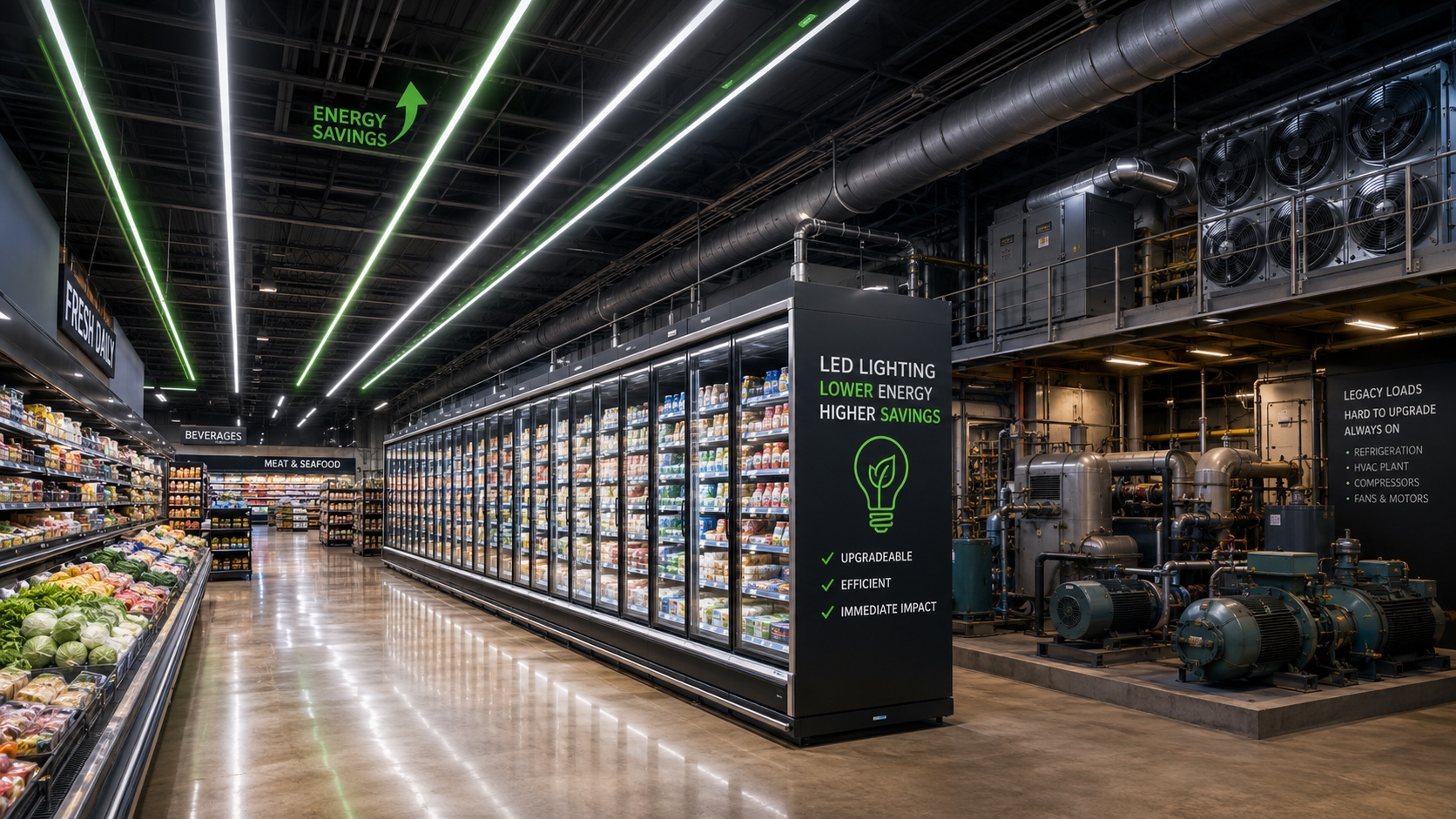
Why LED Lighting Is the Easiest Win in Commercial Energy Reduction
Ask any energy consultant what the fastest, lowest-disruption way to cut a commercial electricity bill is. Lighting. Every time. Not because it's exciting, and not because the technology is new. Because of something most energy discussions skip over.
Most of what your building consumes is not under your control. Lighting is one of the few things that is.
The fixed load problem
Walk through a commercial or industrial site and start cataloguing the energy loads. What you find, almost without exception, is that the majority of consumption is locked in. Decisions made years ago, about equipment, building design and operational requirements, that can't be revisited without a capital project.
Refrigeration and cold storage
Compressors in cold rooms, freezer stores and display cases run according to thermodynamics. The heat load they are fighting is set by the ambient temperature, the building's insulation, how often the doors open and the thermal mass of the product inside. None of that changes because you want a lower bill.
You can improve refrigeration at the margins. Better door seals, night blinds on display cases, more frequent coil defrost. But the fundamental load is set by the plant you installed and the building it sits in. Replacing that plant is a six-figure decision, not something you do to fix this quarter's energy costs.
HVAC and air conditioning
Same story. Energy consumed by your HVAC is largely determined by the climate, the building's insulation and glazing, the occupancy and equipment heat loads inside, and the efficiency of the installed plant. Setpoint adjustments help at the margins. Variable speed drives on pump and fan motors help a bit more. The fundamental load is still baked in.
Process equipment and machinery
In manufacturing and industrial settings, the energy consumed by process gear, presses, conveyors, compressors, CNC machines, is set by the process. The energy cost of forming a component or filling a bottle is what the physics requires. You can schedule around peak tariff periods and add VFDs to motors that don't need to run flat out. But you can't reduce the energy cost of the process without changing the process.
Hot water systems
Electric resistance hot water heaters are expensive to run in commercial kitchens and laundries. Heat pump systems cut that significantly, typically delivering 3 to 4 units of heat per unit of electricity. But they are a capital replacement, not a retrofit. And the load doesn't go away, it just costs less per litre.
Why lighting is different
Against that backdrop of locked-in loads, lighting stands out as genuinely actionable. Three things make it different from almost everything else on the energy bill.
1. The drop-in technology exists
LED replacements exist for virtually every commercial and industrial lighting application still running in Australian buildings. T8 and T5 fluorescent tubes, metal halide high bays, HPS street and area lights, halogen downlights, CFL compact fluorescents. Every one of them has a direct LED equivalent that fits the same mounting point and delivers the same or better light output at 40 to 70 per cent less power.
There is no equivalent drop-in for a refrigeration compressor. There is no retrofit kit for an injection moulding machine. Lighting is unique in having a mature, cost-effective replacement technology that needs no process change, no building modification, and no operational disruption to install.
2. Installation does not shut you down
Most commercial LED upgrades are done outside business hours. Evenings, weekends, or a planned shutdown. A warehouse with 50 metal halide high bays can typically be done in a single weekend. Monday morning the place opens with better light and a lower energy draw. There is no equivalent "do it on the weekend and start saving on Monday" option for HVAC, refrigeration or process equipment.
3. The payback is calculable before you spend anything
The energy saving from an LED upgrade is predictable. It is a direct function of the wattage reduction, your operating hours, and your electricity tariff. The financial case can be modelled precisely before any money changes hands. For most commercial and industrial applications in Australia, payback periods of one to three years are realistic. In South Australia at 42c/kWh, or for facilities running long hours, under 12 months is common.
NSW ESS, Victorian VEU and SA REPS rebate schemes cut payback further by subsidising the capital cost.
What lighting actually costs you
It helps to look at what lighting typically represents on the power bill across different facility types. These figures are based on Australian energy audit data and AEMC building energy use surveys.
| Facility type | Lighting share of bill | Typical LED saving | Net bill reduction |
|---|---|---|---|
| Office building | 25 to 40% | 50 to 65% | 13 to 26% of total bill |
| Retail (supermarket) | 30 to 45% | 40 to 60% | 12 to 27% of total bill |
| Warehouse / distribution | 15 to 25% | 55 to 70% | 8 to 18% of total bill |
| Manufacturing / industrial | 10 to 20% | 50 to 65% | 5 to 13% of total bill |
| Cold storage / food processing | 8 to 15% | 55 to 70% | 4 to 10% of total bill |
| Hospitality / accommodation | 20 to 35% | 60 to 75% | 12 to 26% of total bill |
| Car park (underground) | 60 to 80% | 50 to 65% | 30 to 52% of total bill |
Car parks illustrate the point bluntly. When lighting is the dominant load because there is almost nothing else running, a 50 to 65 per cent reduction in lighting energy cuts the total electricity bill by 30 to 52 per cent. That is from a standard LED retrofit. Not a building redesign.
What waiting actually costs
A 400W metal halide high bay running 16 hours a day, 5 days a week costs around $1,500 per year in electricity at 30c/kWh. A 140W LED replacement delivering equivalent light output costs around $530. The difference is $970 per fitting per year, every year, for the life of the fitting.
A warehouse with 50 of those fittings is spending roughly $48,500 a year on lighting. An LED upgrade at $26,500 reduces that to $16,500 and saves $32,000 annually from that point on. Every year the upgrade does not happen is $32,000 that does not stay in the business.
The maths that gets ignored: An LED upgrade is not a one-off saving. It recurs every year for the life of the fitting. A $32,000 annual saving over 10 years is $320,000 in cumulative savings from a single project. The fitting you install today is still saving you money in 2036.
How it compares to the alternatives
For context, here is how an LED lighting upgrade compares to other common commercial energy reduction measures.
| Measure | Typical capital cost | Payback period | Disruption | Energy saving |
|---|---|---|---|---|
| LED lighting retrofit | Low to medium | 1 to 3 years | Minimal | 40 to 70% of lighting load |
| VFD on HVAC motors | Medium | 2 to 5 years | Moderate | 20 to 40% of motor load |
| Rooftop solar PV | High | 4 to 8 years | Low | Offsets daytime consumption |
| Building insulation upgrade | High | 5 to 15 years | High | 10 to 30% of HVAC load |
| HVAC plant replacement | Very high | 7 to 15 years | High | 20 to 40% of HVAC load |
| Refrigeration replacement | Very high | 8 to 15 years | High | 15 to 30% of refrigeration load |
LED lighting consistently gives you the best combination of low capital cost, fast payback and minimal disruption of anything on that list. That is not an argument against the other measures. It is an argument for doing the LED upgrade first, banking the savings, and using that cash flow to fund the next project.
On the solar question: Solar is often pitched as the first step in commercial energy reduction. An LED upgrade done first reduces your daytime consumption, which reduces the solar system size you actually need. LED first, then solar, is more cost-effective than solar alone. If you are planning battery storage as well, the LED upgrade improves those economics too.
The phase-out adds urgency
Australia is phasing out fluorescent lamps under GEMS regulations. T8 and T5 tubes are progressively removed from sale between 2026 and 2027. Businesses still running fluorescents are facing a forced transition regardless. The question is whether you plan it properly or scramble when the stock dries up.
A planned upgrade with lumen-based specifications and access to rebate schemes costs less and works better than an emergency replacement when the fluoros start failing and the shelves are empty.
Running the numbers
The starting point for any LED upgrade project is knowing what your current lighting actually costs, what an LED replacement would cost, and what the payback looks like at your actual tariff in your actual state.
The LED Savings Calculator uses lumen-based equivalence rather than the watt-substitution tables most suppliers quote from, and real Australian state tariffs rather than US figures that make the numbers meaningless locally. Put in your lamp type, operating hours, number of fittings and state. You get annual energy savings, payback period, and once you add your actual product and install costs, a full 10-year financial projection with applicable rebates for NSW, VIC and SA.
 Calculate your LED lighting savings
Real Australian state tariffs · Lumen-based calculations · NSW ESS, VEU and SA REPS rebate estimates
Open the LED Savings Calculator →