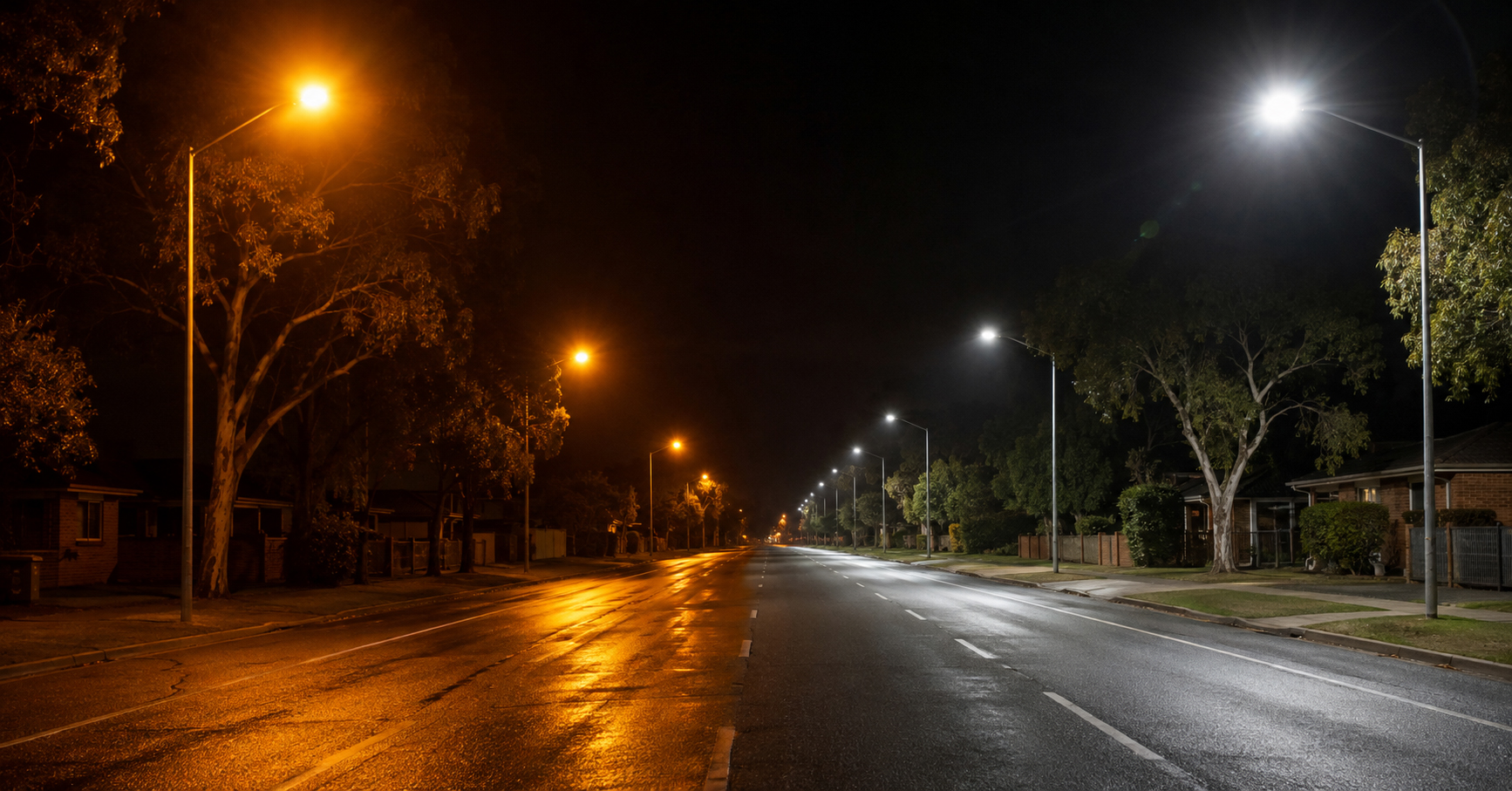
A council in Sydney's north replaces 2,000 streetlights. Approved luminaires, compliant photometrics, correct installation. The quarterly bill from Ausgrid arrives. It is unchanged. The energy manager spends three weeks trying to work out where the savings went.
They went nowhere. The council was on an unmetered tariff. The tariff is based on the luminaire category, not actual consumption. You can dim the lights to 30% every night from midnight. The bill does not move. That is the street lighting trap that no one mentions in the LED sales brochure.
Street lighting is council's largest energy cost. It runs every night, all year, on infrastructure the council often does not own, billed under a tariff the council did not negotiate, governed by a standard most lighting contractors have not read. This article covers what actually matters.
Before touching any other topic: ownership. In most of Australia, the distribution network service provider (DNSP) owns the poles and much of the infrastructure. The council is the road authority responsible for ensuring adequate lighting, but does not own the assets. This distinction controls everything: what you can upgrade, how, at what cost, and what tariff applies.
Ausgrid covers metropolitan Sydney, Central Coast and Hunter (230,000+ lights). Councils are the road authority. Ausgrid owns the infrastructure and provides public lighting as a regulated service. Upgrades are co-funded: Ausgrid provides capital, councils repay over 10 years through the tariff.
Victoria has a higher proportion of council-owned lights than NSW. Powercor manages 205,000 public lights across western and central Victoria; CitiPower covers inner Melbourne. 86% are already LED. Councils and DNSP share responsibility depending on the asset.
Energex in south-east Queensland, Ergon in regional Queensland. Structure broadly similar to NSW. Council is road authority, DNSP provides the public lighting service. LED rollouts have been active across Brisbane and Sunshine Coast through Energex programs.
Western Power provides public lighting across the South West Interconnected System. ATCO covers gas but not electricity. WA councils have had more friction in LED upgrade processes due to Western Power's procurement and approval requirements.
SA and ACT: SA Power Networks (SAPN) covers South Australia. ActewAGL covers the ACT. Both operate on similar DNSP-ownership models. South Australia has been active on LED street lighting through the Department for Infrastructure and Transport coordination with SAPN.
Street lighting in Australia is governed by AS/NZS 1158, which has multiple parts covering different applications. The two you need to understand are Part 1.1 (vehicular traffic, luminance method) and Part 3.1 (pedestrian area and local roads, illuminance method). These are not interchangeable and they measure completely different things.
| Part | Coverage | Measurement | Unit | Who sees the result |
|---|---|---|---|---|
| AS/NZS 1158.1.1 | Category V: vehicular traffic roads | Luminance | cd/m² | The driver's eyes |
| AS/NZS 1158.1.2 | Category V: vehicular traffic roads (alternative) | Illuminance | lux (lx) | The road surface |
| AS/NZS 1158.3.1 | Category P: pedestrian areas and local roads | Illuminance | lux (lx) | The road/path surface |
| AS/NZS 1158.2 | Computer calculation procedures | Both | Both | Design verification only |
This is the concept that trips up every building electrician who ventures into street lighting for the first time. Illuminance is what you measure with a lux meter held flat on the ground. It tells you how much light is hitting the surface. Luminance tells you how much light is reflected from that surface into a driver's eyes.
Two roads can have identical illuminance and completely different luminance. A fresh white concrete surface reflects far more light toward the driver than worn dark bitumen. A light installation that complies on one surface type may fail on another, even with the same fittings at the same spacing.
The R-table problem: AS/NZS 1158.1.1 uses r-tables (R1 through R4) to categorise road surface reflectivity. R1 is primarily diffuse (concrete). R2 is typical sealed bitumen. R3 is moderately specular. R4 is highly specular. Most Australian roads are R2 or R3. A compliance calculation done assuming the wrong r-table will produce the wrong result. Always confirm the road surface type before calculating.
For Category V roads (arterials, collectors), the primary compliance method is luminance. You calculate the average carriageway luminance (Lav) in cd/m² that a driver at a standard observation point actually perceives. This is why road lighting design requires photometric software and r-table data, not just a lux meter.
Category V lighting is classified V1 through V5 based on road type, traffic volume, and operating speed. The category is assigned by the road authority (usually the state roads agency or council for local roads) before the lighting designer touches the project.
| Category | Typical Application | Avg Luminance (Lav) | Overall Uniformity (Uo) | Longitudinal Uniformity (Ul) |
|---|---|---|---|---|
| V1 | Busiest arterials, high-speed major roads | 2.0 cd/m² | ≥ 0.40 | ≥ 0.70 |
| V2 | Main arterials, significant traffic volume | 1.5 cd/m² | ≥ 0.40 | ≥ 0.70 |
| V3 | Collector roads, sub-arterials, some motorways | 1.0 cd/m² | ≥ 0.40 | ≥ 0.50 |
| V4 | Local distributor roads, lower-volume roads | 0.5 cd/m² | ≥ 0.40 | ≥ 0.50 |
| V5 | Minor local roads, very low traffic | 0.5 cd/m² | ≥ 0.40 | ≥ 0.40 |
These are maintained luminance values, not initial. The design must account for luminaire lumen depreciation over time. A new installation that just scrapes 2.0 cd/m² at commissioning will fail V1 after three years of lumen drop. Design with the maintenance factor applied from the start.
Category P covers footpaths, local residential roads, pedestrian crossings, shared paths, and public spaces. Unlike Category V, it uses horizontal illuminance (lux) rather than luminance. Category P lighting is assessed under AS/NZS 1158.3.1, with subcategories PR (local roads) and PP (pathways).
| Subcategory | Application | Avg Horizontal Illuminance (Eh) | Min Point Illuminance (EPh) |
|---|---|---|---|
| PR1 | Busiest local roads | 7 lx | 2 lx |
| PR2 | Moderately trafficked local roads | 3.5 lx | 0.7 lx |
| PR3 | Typical residential streets | 1.75 lx | 0.3 lx |
| PR4 | Quieter residential streets | 1.3 lx | 0.22 lx |
| PR5 | Low-volume local roads | 0.85 lx | 0.14 lx |
| PP1 | High-use footpaths, high fear-of-crime areas | 10 lx | 2 lx |
| PP2 | Moderate-use footpaths | 7 lx | 1 lx |
| PP3 | Standard footpaths | 3 lx | 0.5 lx |
| PP4 | Medium pedestrian/cycle activity, low fear-of-crime pathways | 1.5 lx | 0.25 lx |
| PP5 | Low pedestrian/cycle activity, low fear-of-crime pathways | 0.85 lx | 0.14 lx |
Pedestrian crossings: At-grade pedestrian crossings on a Category V road require illuminance calculated separately for the crossing zone, with vertical illuminance requirements in addition to horizontal. The crossing must be visually prominent to approaching drivers. This is one of the most commonly under-lit elements in existing street lighting infrastructure.
LED wins in street lighting for three reasons that go beyond simple wattage comparison.
HPS is omnidirectional. About 35% of its light goes up or sideways, requiring reflectors to redirect it. LED is inherently directional. At equivalent installed watts, more lumens reach the road surface. Road lighting photometrics improve significantly.
AS/NZS 1158.3.1 requires lumen derating for sources with an S/P ratio below 1.0. High-pressure sodium has a lumen multiplier of 0.75 under the standard. LED (CCT ≥ 2500K) has no derating. This means HPS delivers 25% fewer effective lumens than its label suggests.
LED dims cleanly from 100% to 10% without lamp damage or restart delays. HPS cannot be dimmed below about 50% without inverter technology, and relighting after an outage takes 5 to 10 minutes. For adaptive dimming strategies, LED is the only practical option.
HPS luminous efficacy peaks at around 90 to 100 lm/W. LED systems are shipping at 150 to 180 lm/W and improving. HPS also produces most of its light at yellow wavelengths; the human eye at low scotopic light levels is far less sensitive to yellow than white. HPS is effectively losing the same race fluorescent lost in buildings.
The combined effect: an LED street light at 60W can replace an HPS at 150W and meet the same luminance category. That 60% wattage reduction is real. The savings question is whether the tariff structure lets the council see it.
Adaptive dimming means the luminaire output changes based on time, occupancy or traffic data. In theory, lights go to 30% at 2am on an empty residential street and full output at peak hours. In practice, there are meaningful constraints on what supply authorities allow.
Fixed dim schedule. Typically: full output from dusk to 10pm, then a set percentage until dawn. Requires no sensors. Ausgrid and Powercor both allow this on smart-control luminaires. Minimum output level during operating hours is subject to the applicable AS/NZS 1158 category being maintained at the dimmed level.
Zhaga-socket-based control nodes communicate individual luminaire status, fault detection and dimming commands over mesh network. Ausgrid's 62,000 major-road LED rollout includes smart controls on each fitting. Councils get fault reporting, remote dimming control, and energy monitoring per luminaire.
Luminaire dims when no vehicles or pedestrians are detected and restores to full output on detection. Approved in principle but requires individual risk assessment for Category V roads. Generally more accepted on Category P roads and shared paths. Not standard in Ausgrid or Powercor mainstream programs as of 2026.
You cannot dim a V2 road to a point where Lav drops below 1.5 cd/m², even at 3am. The road category applies at all times the road is designated as lit. Dimming to a level that breaks the luminance category is a compliance failure regardless of time of day or traffic volume.
This is the issue SSROC (representing 29 Sydney councils) has been pursuing through multiple AER regulatory reviews. It is worth understanding clearly.
In NSW, Ausgrid's public lighting tariff is unmetered. The council is charged a fixed monthly rate per luminaire based on the luminaire's category and wattage band, not its actual energy use. The tariff is approved by the Australian Energy Regulator (AER).
The dimming paradox: If you install a 50W LED on a smart control and dim it to 25W from midnight to 6am every night, you have halved overnight consumption. On an unmetered tariff, you have saved zero dollars. The tariff rate is fixed to the luminaire class. The energy saving is real. The bill saving is not.
The solution is connected luminaires with metering under a metered tariff arrangement. This is what Ausgrid's smart controls program delivers: when a luminaire is on the smart control network, actual consumption is measurable, and the tariff can reflect real usage. Councils pushing for off-peak dimming savings need to be on metered tariff arrangements, not the legacy flat-rate structure.
Victoria's situation is slightly different. Under the Victorian Electricity Distribution Code, public lighting is classified as an alternative control service. Powercor's public lighting tariffs are separate from standard network tariffs and have been the subject of regulatory scrutiny on fair cost allocation. Councils in Powercor territory should review their current tariff classification before assuming dimming savings will flow through.
Ausgrid is the single largest street lighting network operator in Australia. Understanding how it works in NSW applies, with variations, across most metropolitan councils.
Ausgrid funds the capital cost of luminaire upgrades. Councils repay through an ongoing charge embedded in the tariff, typically over 10 years. The council does not choose any luminaire from any supplier: the luminaire must be on Ausgrid's Approved Product List (APL). This list controls which products qualify for the appropriate tariff category and ensures photometric compliance with AS/NZS 1158 is maintained across the network.
Ausgrid's 62,000 major-road LED replacement program (completed in partnership with 33 councils) includes Zhaga-compatible smart control nodes on each luminaire. Each node enables individual fault reporting, remote dimming, and data collection. Additional sensor ports allow councils to install third-party smart city devices (pedestrian counters, air quality sensors) on the same pole without separate approval.
SSROC's 2024 submission to the AER noted that Ausgrid's column pricing (the charge for owning and maintaining the pole) runs 70 to 90% higher than other NSW DNSPs. This disproportionately affects Central Coast and Hunter councils that have a higher proportion of standalone street lighting columns versus mast-mounted lights. It is a meaningful cost that councils often overlook when budgeting upgrade programs.
Ausgrid has specific CCT requirements. Residential streets: 3000K. Arterials and major roads: 4000K. The 3000K limit on residential roads comes from community and astronomical observatory feedback about blue-heavy white light in sleeping areas. You cannot specify a single CCT across a mixed network and expect compliance from Ausgrid.
Minor capital works process: Any change outside Ausgrid's standard upgrade program (adding a luminaire, relocating a pole, upgrading a pedestrian crossing) goes through a Minor Capital Works or Contestable Works process. SSROC has documented widespread council frustration with cost, complexity and delays in this process. Budget for it and build it into project timelines.
Victoria's structure differs from NSW in ways that matter for project planning.
With 86% of Powercor's 205,000 public lights already LED, the remaining 14% are typically decorative, heritage-style, or specialty fittings. The LED conversion problem is mostly solved on the standard network. Current issues are more about smart controls deployment and tariff structure than basic luminaire upgrades.
Councils in Powercor territory with council-owned assets (not Powercor-managed) have more flexibility on product selection and dimming schedules, but retain full maintenance responsibility. The trade-off is real: council-owned lights give procurement freedom but remove Ausgrid-style subsidised capital programs.
VicRoads (now the Department of Transport and Planning) retains control over lighting standards on arterial roads regardless of who manages the lights. A council wanting to change lighting on a state arterial that passes through their municipality needs DTP approval, not just Powercor approval.
This stops projects before they start. A contractor who does not know this will specify a product, win the tender, order the luminaires, and then discover the council cannot use them because they are not on the DNSP's approved list.
Ausgrid maintains an APL of LED street luminaires that have been assessed for:
Luminaires not on the APL:
The APL changes over time as Ausgrid assesses new products. Before specifying any luminaire for a council project in Ausgrid territory, confirm current APL status directly with Ausgrid. Do not rely on a supplier's claim that their product is approved.
Building compliance (AS 1680) uses lux. Road compliance (AS/NZS 1158.1.1) uses luminance on vehicular roads. A spec that says "minimum 15 lux on arterial road" is using the wrong metric. You may have too much or too little light and no way to know without the luminance calculation.
A collector road incorrectly categorised as V4 instead of V3 will be under-lit. The category should be set by the road authority before the lighting designer starts work. On council roads this is usually the council engineer, on state roads it is the state transport agency.
Covered above, but worth repeating: unmetered tariff equals no bill savings from dimming. Councils need to confirm their tariff structure before investing in smart controls for energy savings. Smart controls still deliver maintenance benefits on unmetered tariffs.
A design done on R1 (concrete) reflectivity submitted for an R2 bitumen road will produce a non-compliant installation. The r-table must match the actual road surface. For reseal projects, check whether the new surface type changes the r-table before signing off on the lighting design.
Dimming profiles must be checked against the road category. A V2 road dimmed to 70% at midnight is still required to maintain 1.5 cd/m². If the luminaire at 70% delivers 1.3 cd/m², it fails regardless of time. Design the dimming schedule with photometric verification, not guesswork.
The project gets approved, luminaires are ordered, then Ausgrid rejects the product. This kills project timelines. Check APL status before specification, not after tender award.
Specifying 4000K across an entire network that includes residential streets will create problems with Ausgrid. The 3000K residential requirement is not negotiable. Zone the network by road type and specify CCT accordingly from the start.
Any deviation from standard Ausgrid upgrade parameters adds time and cost through the MCW or Contestable Works process. Pedestrian crossing upgrades, additional luminaires, relocated poles: all go through this process. Budget 3 to 6 months and associated fees.
Given the constraints above, here is what moves the needle.
Engage your DNSP's public lighting program early. Ausgrid and Powercor both have dedicated public lighting teams. Councils that work within these programs get subsidised capital, APL-compliant products, and access to smart control infrastructure. Councils that go independent face more complexity and cost.
Push for metered tariff arrangements on smart-control luminaires. This is the path to capturing dimming savings on the bill. SSROC's advocacy with Ausgrid and the AER has made progress here: the 2024-29 pricing review introduced more granular pricing. Councils need to confirm their current tariff classification and ask whether smart-control luminaires qualify for metered or consumption-based charging.
Prioritise pedestrian crossings. Many existing crossings are non-compliant with Category P requirements, particularly vertical illuminance on the crossing face. Fixing crossings is achievable through MCW without full network upgrade. It is also where community safety impact per dollar spent is highest.
Commission proper photometric verification on installation. Do not accept a contractor's word that the installation complies. Get the as-built photometric calculations in writing. For Category V roads, this means a qualified lighting designer signing off on the luminance calculations, not just a lux reading from a meter on the road surface.
Check Zhaga compatibility before buying anything. If the council is in Ausgrid territory and plans to use smart controls, the luminaire must have a Zhaga socket (the standardised control interface). This is now a de facto requirement for any luminaire that will connect to the Ausgrid smart lighting network.
The smart city sensor opportunity: Ausgrid's main-road LED luminaires installed from 2024 onwards include additional sensor ports for third-party devices. Councils can install pedestrian counters, environmental sensors, EV charging indicators or parking availability sensors on the same infrastructure without separate pole approval. SSROC is negotiating revenue-sharing arrangements with Ausgrid for sensor data. This is where smart street lighting actually becomes a council asset, not just an energy cost.
Before specifying a luminaire, confirm: what DNSP owns the infrastructure, what category (V or P) applies to each road, whether the luminaire is on the APL, what CCT is required for that road type, whether the tariff is metered or flat-rate, and whether dimming profiles have been verified against the maintained luminance threshold at the dimmed level.
Street lighting is not a product problem. The LEDs exist. The wattage reductions are real. The barrier is understanding the regulatory and commercial structure that sits between a council and its street lighting bill, and navigating it in the right order.
LED street lighting cuts energy consumption by 50–70% versus HPS. Use the calculator to model payback and savings across your council's network.
Open the Calculator →