NSW ESS Commercial Lighting Certificates Are Gone: What It Means for Your LED Upgrade
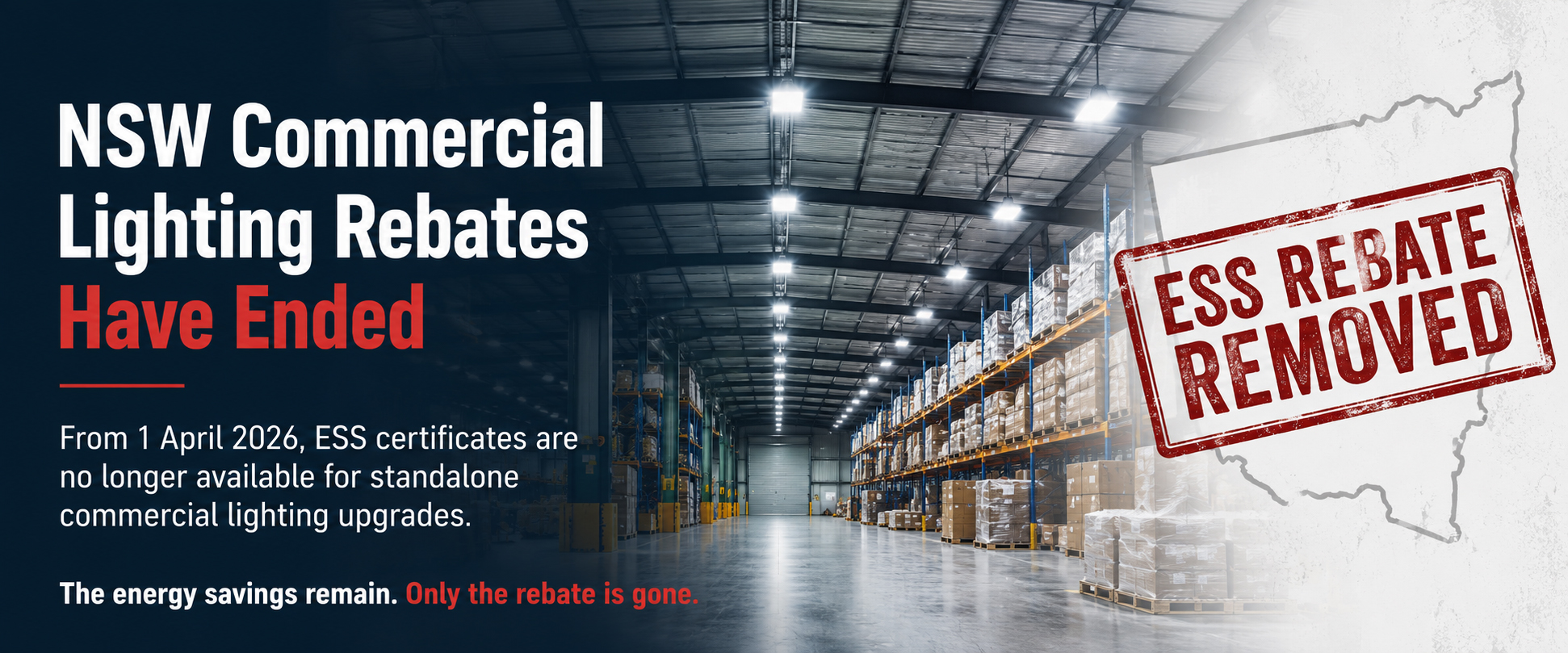
The short version: From 1 April 2026, commercial lighting upgrades in NSW are no longer eligible for Energy Savings Certificates under the standard ESS method. The CLESF calculation formula that funded LED rebates for commercial sites has been removed from the scheme rules. If a contractor is promising you NSW ESS rebates for a lighting-only job quoted or completed after that date, those certificates cannot be created.
The NSW Energy Savings Scheme has been funding commercial LED upgrades for years. Businesses across the state have used it to cut the capital cost of lighting retrofits, sometimes dramatically. A 50-fitting warehouse job that might cost $50,000 self-funded could come in at $35,000 or less with ESS certificates factored in.
That mechanism no longer exists for standalone commercial lighting. Here is what changed, why, and what options are actually left.
What was CLESF and why did it exist
The Commercial Lighting Energy Savings Formula (CLESF) was the calculation method within the NSW ESS that determined how many certificates a commercial lighting upgrade would generate. It worked on a deemed saving basis: replace a 400W metal halide with a 150W LED, apply an assumed operating hours figure for your facility type, multiply by a deemed lifetime, and the result was a certificate count the installer could sell to electricity retailers.
It was administratively simple. Installers knew the numbers upfront, could price jobs accordingly, and clients got predictable rebates. That simplicity was both its strength and its problem.
The scheme rules set deemed operating hours by facility type: commercial offices ran at one assumption, warehouses at another, retail at another. The actual hours a specific site ran did not matter. A warehouse that operated 16 hours a day generated the same certificates as one running 8 hours, because the formula used the same assumed figure for both.
Over time the NSW Government concluded this produced windfall certificate creation in cases where the assumed hours significantly overstated real usage. The formula was not measuring actual savings. It was generating certificates based on assumptions that were increasingly disconnected from what buildings were actually doing.
What changed and when
NSW Government removes CLESF from the ESS Rule. Accredited Certificate Providers are notified. A transition period is announced for jobs already quoted or underway.
Last day for ACPs to register Energy Savings Certificates for commercial lighting upgrades under the old CLESF method. Jobs completed before this date and registered in time were still valid.
Commercial lighting upgrades completed from this date onwards are no longer eligible for NSW Energy Savings Certificates under the standard ESS method. No new CLESF-based certificates can be created.
The transition period was a practical acknowledgment that some businesses had already received quotes incorporating ESS certificate value. Contracts had been signed with rebate expectations baked in. The deadline gave ACPs time to honour those commitments without leaving businesses exposed mid-project.
What this means in dollar terms
For context on what has been removed, a typical commercial upgrade under the old CLESF method generated roughly these certificate values:
| Upgrade scenario | Fittings | Typical ESC value (old scheme) | Status from April 2026 |
|---|---|---|---|
| 400W metal halide to 150W LED high bay | 50 | $12,000–$20,000 | No longer available |
| 36W T8 fluorescent to LED tube (office) | 200 | $4,000–$8,000 | No longer available |
| 400W HPS car park to 100W LED | 80 | $10,000–$16,000 | No longer available |
| Any commercial lighting upgrade (VIC VEU) | Any | $50–$150/fitting | Still available |
| Any commercial lighting upgrade (SA REPS) | Any | Variable | Still available |
For a warehouse owner in NSW who was planning a lighting upgrade with ESS certificates in the budget, this is a meaningful change. A project that came in at $35,000 after certificates now comes in at $50,000 without them. The energy saving is identical. The upfront cost is not.
Is there any alternative within the NSW ESS
Technically, yes. Practically, not for most commercial lighting projects.
The NSW ESS still allows energy efficiency projects to generate certificates through a method called Project Impact Assessment with Measurement and Verification (PIAM&V). This is a measurement-based approach rather than a deemed saving formula. Instead of applying assumed hours and wattages, a PIAM&V project measures actual baseline energy use, then measures actual post-upgrade energy use, and calculates certificates from the real difference.
The problem is complexity and cost. PIAM&V projects require:
Metering baseline consumption before the upgrade. Engineering assessment and methodology documentation. Post-installation monitoring. Verification by an independent measurement and verification professional. Ongoing reporting obligations.
For a major multi-upgrade industrial project spanning HVAC, motors, compressors and lighting, PIAM&V can be worth it. The certificate value across the whole project justifies the compliance overhead. For a lighting-only commercial job, the measurement and verification cost typically exceeds the certificate value by a substantial margin.
The NSW Government has acknowledged this. In the position paper accompanying the ESS Rule change, they noted: "The NSW Government also recognises that it may be hard to do lighting projects under multi-upgrade PIAM&V projects and will review this for future ESS Rule updates."
Which is a polite way of saying: they know standalone lighting is effectively excluded, and they may address it eventually.
If a contractor quotes you NSW ESS for a standalone commercial lighting job completed after 1 April 2026, ask them exactly which ESS method they are using. If the answer is CLESF, those certificates cannot be created. If they say PIAM&V, ask for the compliance cost breakdown. The M&V overhead almost certainly makes it unviable for a lighting-only project.
What if I was already quoted with ESS included
If you received a quote before April 2026 that incorporated ESS certificate value as a discount, the situation depends on when the work was completed and registered.
Work completed and certificates registered before 31 March 2026: valid under the transition provisions. No issue.
Work quoted before the cut-off but not completed until after 1 April 2026: the transition period did not cover this. Certificates cannot be registered for work completed after the deadline. If your quote included ESS value and the job has not been done yet, that value is gone. Talk to your contractor about how this affects the pricing before proceeding.
Work quoted after the cut-off with ESS included: either an error or a misrepresentation. In both cases, get clarification in writing before signing anything.
What to do now if you are in NSW
The LED upgrade still makes financial sense
The energy saving does not change because the certificate scheme changed. A 400W metal halide drawing power for 10 hours a day still costs the same to run. A 150W LED replacement still saves 250W per fitting per hour. At NSW grid rates of 28 to 40c/kWh depending on your tariff, a 50-fitting warehouse upgrade still saves $15,000 to $20,000 a year in electricity. The payback is longer without the rebate, but it is still a solid investment.
The LED Savings Calculator uses real NSW tariff data and does not assume ESS certificates. The payback figures it produces reflect the actual energy saving, which is what you will still receive.
Combine with solar to improve the economics
With the ESS rebate gone, the fastest way to improve the LED payback in NSW is to combine it with rooftop solar. LED reduces your daytime consumption. Solar covers part of that reduced load at zero marginal cost. The combined project has a better return than either alone, and solar still attracts Small-scale Technology Certificates (STCs) upfront. How the combined pitch works in detail.
Consider the instant asset write-off
For small businesses with turnover under $10 million, the LED upgrade qualifies for the instant asset write-off, provided the per-asset cost is within the current threshold. At 25 per cent company tax, that returns a meaningful Year 1 tax benefit that partially offsets the loss of ESS certificate income. It is not the same as a direct rebate, but it is real money and it is available now. Check current thresholds with your accountant.
VEU and REPS are unaffected
If you operate in Victoria or South Australia, none of this applies. VEU and SA REPS continue to function as normal for commercial lighting upgrades. Queensland, WA and the other states remain unchanged in that they have no state-level commercial lighting rebate scheme and never did.
The longer view
The NSW Government's position paper signals they intend to review PIAM&V accessibility for lighting projects in future rule updates. That could mean a simpler measurement pathway becomes available at some point. It could also mean the review concludes the existing PIAM&V framework is adequate and no changes are made.
Planning an upgrade around a scheme that might come back is not a strategy. The energy cost of running old technology keeps accruing every week the upgrade does not happen. At NSW tariffs, a 50-fitting warehouse running old metal halides is spending around $800 a week more than it would with LEDs in place. That is the actual cost of waiting.
The rebate made a good investment great. Without the rebate, the investment is still good. The maths are slower, but they still work.
 Run the NSW numbers without the rebate
The LED Savings Calculator uses real NSW electricity tariffs and lumen-based calculations. It does not inflate the numbers with ESS estimates. What you see is the actual energy saving payback.
Open the LED Savings Calculator →